Brain-response media, made visible.
Cortex turns submitted media into a TRIBE v2 cortical-response prediction, a Three.js cortical-surface playback, and four parallel narrations. The first viewer was built during the Nous Research × Kimi sprint; the work later pointed us toward deeper MRI and fMRI research questions that deserve a slower, more rigorous follow-up.
Current Status
Cortex is running locally again on Seratonin, the RTX 5090 desktop, at
http://127.0.0.1:8765. The Cloudflare Tunnel route can expose it
at cortex.redteamkitchen.com, but that route only works while the
PC, the watchdog, and the tunnel are all healthy. The old Tailscale Funnel
URLs are retired and should not be used in public copy.
The durable public path is to publish selected recordings, generated brain-response clips, thumbnails, and scan metadata from Cloudflare Pages/R2, then treat the live app as an optional lab mode rather than the primary demo.
Gallery Artifacts
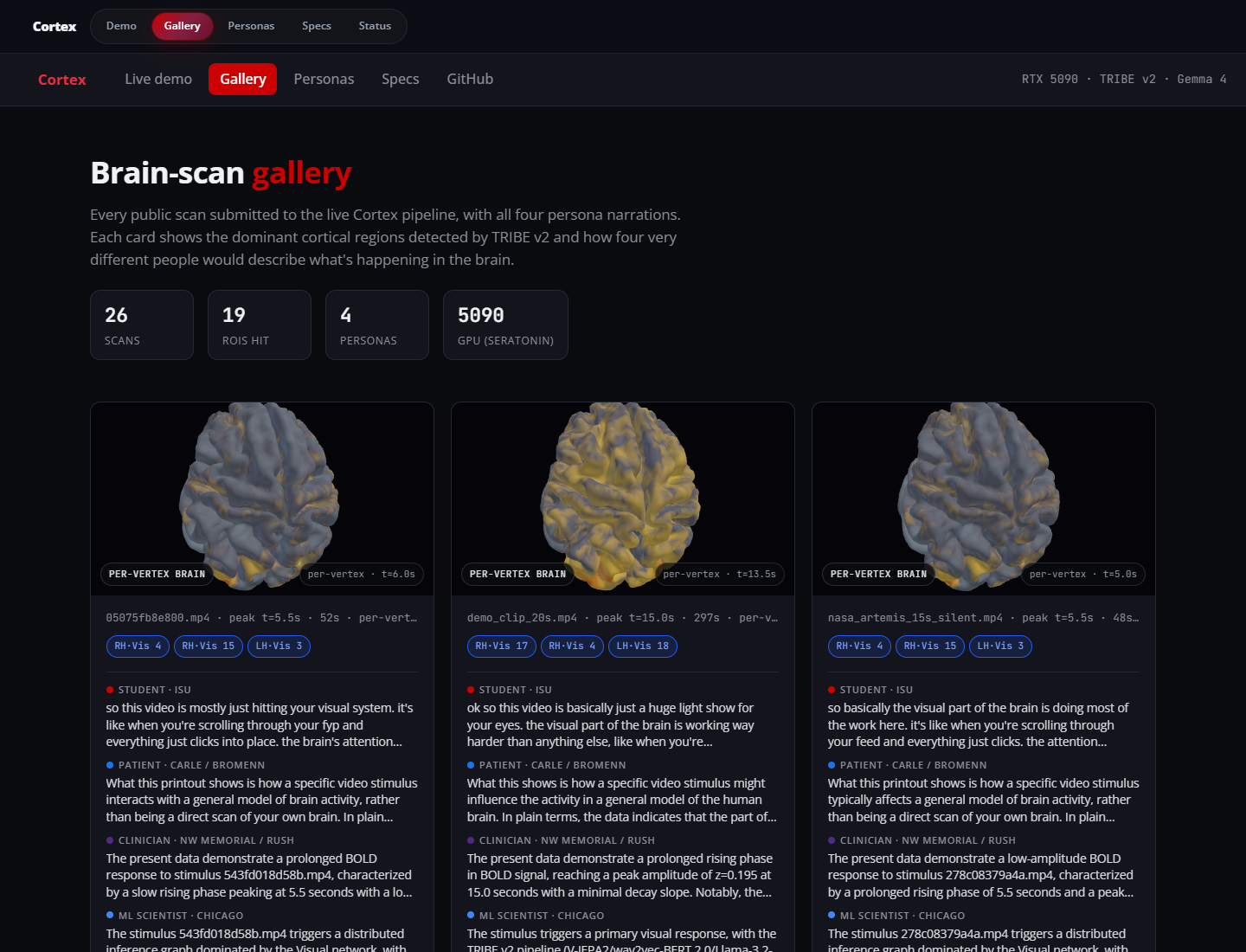
Gallery preview
Completed scans rendered on the 3D cortical surface
The local gallery now uses the same Three.js fsaverage5 brain surface as the live viewer: true per-vertex BOLD when a persisted TRIBE array exists, and regional BOLD fallback for still-image scans. This screenshot is the durable Cloudflare-safe preview while we record a polished public video.
What It Proved
- Working local pipeline: the FastAPI app, TRIBE v2 outputs, Three.js brain-surface previews, and scan registry all work on the local RTX 5090 machine.
- Public strategy change: dynamic uploads should not be the default public promise; static artifacts should carry the website.
- Research direction: the project is a prototype for media-to-brain-response exploration, not a diagnostic tool or a substitute for clinical fMRI.
- Source: github.com/AlexiosBluffMara/cortex.